Hardwood and Parquet Floor Drying in New York City
Pre-war oak parquet and herringbone can usually be dried flat in place if the mats go down before it crowns or lifts.
Hardwood floor drying uses drying mats, controlled dehumidification and daily moisture readings to bring a wet wood floor back to its normal moisture content before the boards distort past the point a sander can fix. In New York the floor in question is often quartersawn oak parquet or herringbone laid in the 1910s to 1930s, glued or nailed over a plank subfloor, and matching that pattern with new material costs far more than saving it. The decision to dry in place or tear out is a money decision, and it has to be made in the first day or two while the wood is still flat enough to save.
Water gets under a wood floor faster than it gets into it. The surface finish sheds the first hour of a spill while the water runs along the joints, drops through to the subfloor and spreads sideways under boards that still look dry from above. By the time the boards cup at the edges the subfloor has been wet for a day or more, so a floor that was mopped up and looks fine can still need drying from underneath. Call as soon as the water is up and the contractor we dispatch can meter the floor before it moves.
What Hardwood Floor Drying Includes
A hardwood drying job starts with a moisture survey of the floor and the subfloor, continues with drying mats and dehumidification sized to the room, and ends with a written record showing the wood back at its normal moisture content. The survey is done with a pinless meter on a grid across the floor and pin readings at the joints and the edges, with a dry standard taken from the same floor in a room the water never reached. Surface finish, board width, whether the floor is nailed or glued and what the subfloor is all go into the plan.
- Moisture mapping across the whole floor and into adjoining rooms, since water under a floor does not stop at a doorway
- A dry standard from the same species and pattern in an unaffected room
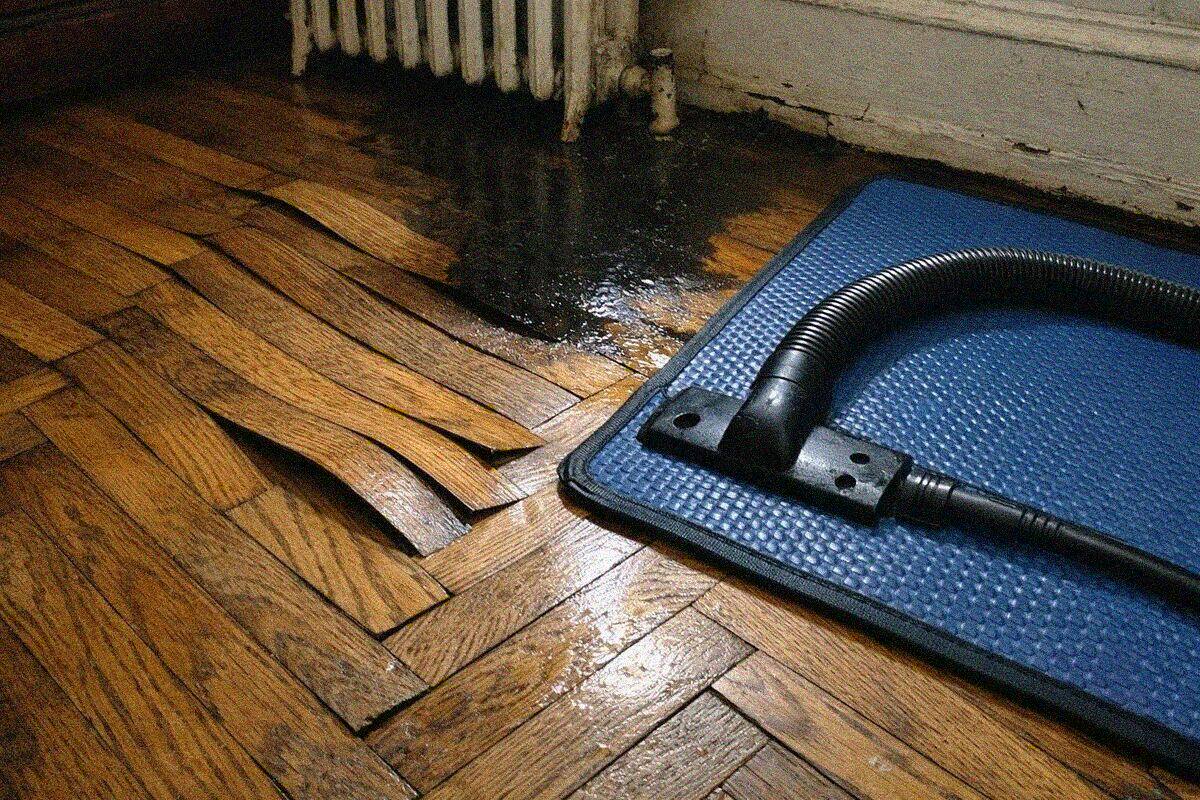
- Drying mats laid over the wet area and connected to a high-pressure blower or a dehumidifier, pulling air down through the joints and out of the subfloor
- Room dehumidification to hold humidity low enough that the mats have somewhere to send the moisture
- Daily readings at the same grid points until the wood meets standard, then a rest period before any sanding is planned
- A written record of the readings for the insurer, the board or the landlord
Cupping, Crowning and the Point of No Return
Cupping is the wet stage and often reversible; crowning is what happens when a cupped floor gets sanded too early.
A wet board takes up moisture on its underside first, so the bottom swells more than the top and the edges rise above the center. That is cupping. The board is wider than it was, the joints press against each other, and in a badly wet floor the whole run lifts off the subfloor in a hump. Cupping is the floor telling you the subfloor is wet, and a cupped floor dried from the underside and left alone will often flatten most of the way on its own.
Crowning is the opposite shape, the center of each board higher than its edges, and it is almost always man-made. Someone sands a cupped floor flat while the underside is still wet, the board finishes drying, the underside shrinks, and the board that was sanded flat now bows the other way. There is no fixing that with another sanding, because the board is already thinner at the edges. This is why the drying record matters before a floor refinisher is booked: the wood has to be at its normal moisture content and stable for a period, and only then does sanding come into it.
Where the floor is past saving is when boards have buckled off the subfloor, when parquet blocks have delaminated from a glued base, when the water was Category 3 sewage, or when the wood has been wet long enough to blacken and grow mold on the underside. The EPA puts mold growth at 24 to 48 hours on wet material, and a floor left a week under a leak often has to come up regardless of how it looks on top.
Drying Mats and How a Floor Is Dried in Place
A drying mat is a low panel laid over the wet boards, sealed at the edges, with a hose to a blower or dehumidifier that pulls air down through the joints of the floor and out through the subfloor. Instead of blowing across the top of a finish that sheds air, it pulls moisture from where it is, underneath the boards. Several mats cover a room, and they get moved along the floor as the readings under each one come to standard. Where the room below is accessible, air movers under the subfloor from the ceiling of the apartment downstairs speed it up, which in a New York building means another neighbor and another access conversation.
Compact air movers like the one in the video below are used around the mats and along the perimeter, and to reach under radiators and into closets where a full-size unit cannot go. The manufacturer explains the placement.

Video: Legend Brands on drying floors in all directions with a compact air mover.
Heat helps and too much heat ruins the floor. A wood floor dried fast with heaters splits and checks, and a parquet floor pulls its glue. Drying is held to a steady moderate temperature and low humidity over days, with readings showing a gradual fall rather than a fast one.
Pre-War Parquet and Herringbone: Why Saving the Floor Is Worth the Effort
Manhattan, Brooklyn and Bronx apartments built before the Second World War were finished with quartersawn white oak in parquet squares, herringbone in the living rooms and hallways, and plain strip in the bedrooms, often with a walnut or mahogany border. Quartersawn oak was chosen because it moves less with humidity than flatsawn, which is also why it survives a wetting better than a modern floor. The blocks are thick, the finish has been sanded and renewed several times over a century, and the pattern is hard to match with new material because the species, the cut, the block size and the color of hundred-year-old oak all have to line up.
Replacing a wet section of pre-war parquet means finding or milling matching blocks, patching them into the pattern, then sanding and finishing the whole room so the patch does not show, and the result is often visibly newer anyway. Drying the original floor flat and refinishing it once keeps the floor and costs less. That is the argument for calling early: the floor that gets mats within a day or two is the floor that stays.
What Drives the Cost of Hardwood Floor Drying in New York
The two figures that frame the decision are the cost of drying and refinishing a floor in place against the cost of replacing it in a matching pattern. Published 2026 trade sources put refinishing a hardwood or parquet floor in New York at roughly 4 to 10 dollars or more per square foot depending on the pattern, the finish and how much repair the sander has to do first. Replacing a matching pre-war parquet or herringbone floor runs well above that because of the milling, the fitting and the full-room finishing that follows. Drying itself is billed by equipment day and mat count, and the general mitigation range from published 2026 national cost surveys, about 3.75 to 7.50 dollars per square foot of affected area, applies with New York at the top. These are references; the figure for your floor comes in writing from the survey.
- Square footage of wet floor, from the moisture map, which is usually larger than the cupped area
- Days to dry standard, longer for thick quartersawn blocks and for a glued parquet base
- Access to the underside: an open ceiling below cuts the drying time and needs the downstairs neighbor to agree
- Whether a section has to come up anyway, because of buckling, delamination, sewage or a week of saturation
- The refinishing scope afterwards, which is a separate trade and a separate line, and whether the whole room or only the affected run is sanded
- Building logistics for the mats, blowers and dehumidifiers: stairs in a walk-up, freight hours and insurance paperwork in a managed building
The practical rule is that saving a pre-war floor is cheaper than replacing it in almost every case where it can be saved, and a written drying plan states which of the two it is before the mats go down so nobody is surprised at the end.
Building Logistics for Floor Drying in an Apartment
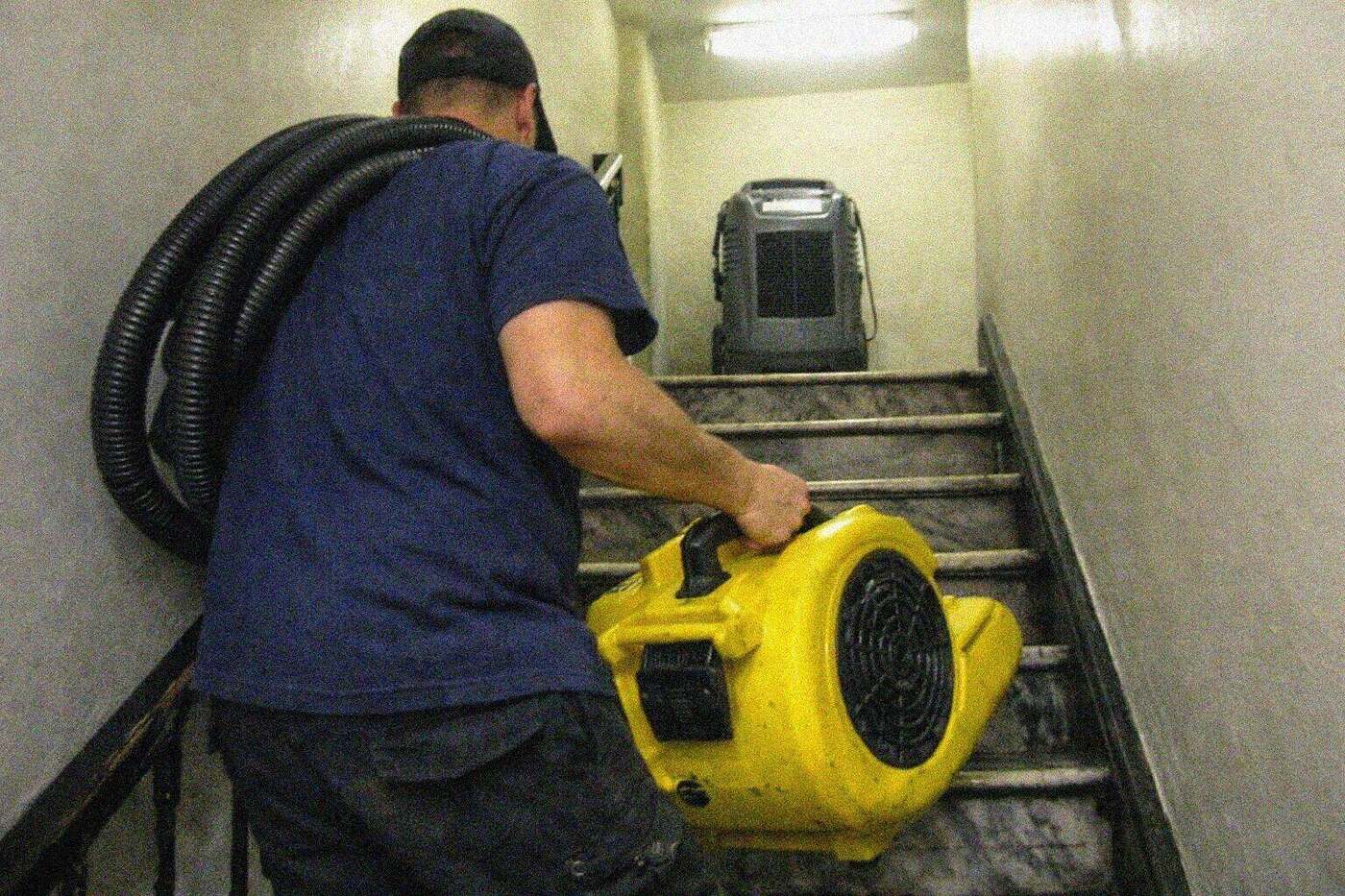
Drying mats and their blowers are quieter than a room full of air movers, but they run for days and a dehumidifier runs with them, so the super and the neighbors below need to know. In a co-op or condo the managing agent will ask for a certificate of insurance and an equipment list before anything comes up the freight elevator, and if the plan includes air movers on the ceiling of the apartment below, the board or the landlord arranges that access. In a walk-up everything comes up the stairs and the plan is sized to what can be carried.
Furniture on the wet floor has to move, and in a Manhattan apartment there is often nowhere to move it to, so pieces get blocked up on the dry side of the room or go into short-term storage. The floor refinisher who comes after the drying needs the room empty as well, and it saves a second move to plan both at once.
Signs a Wood Floor Needs Drying From Underneath
The surface is the last place a wet wood floor shows it.
Edges rising along each board
Cupping means the underside is wetter than the top, and the subfloor beneath it is wet. Mats on the surface within a day or two usually bring it back.
A hollow or rocking parquet block
Water under a glued parquet base softens the adhesive and the block lifts. Caught early the block re-adheres as it dries; left a week it delaminates.
Dark lines at the joints
Water running along the joints stains the end grain first, and dark joints across a run of boards trace where the water traveled under the floor.
A gap opening up at the baseboard
Boards swelling sideways push against the walls, then shrink back as they dry and leave a gap that was not there before. Both stages mean the floor was wet.
A stain on the ceiling of the apartment below
Water that reached the subfloor keeps going, and the downstairs neighbor often sees it before you feel it. Their ceiling is the underside of your floor.
How a Hardwood Floor Drying Call Runs in New York
Call, and stop the water
A person answers at any hour. Find the source or the shutoff, get towels down along the joints, and describe the floor: parquet, herringbone, strip, and how long it has been wet.
Moisture map of the floor and subfloor
The contractor meters the floor on a grid into adjoining rooms and takes a dry standard from the same floor in a dry room, then tells you in writing whether the floor can be dried in place.
Mats, dehumidification and building paperwork
Drying mats go down over the wet area, a dehumidifier holds the room, and the certificate of insurance and equipment list go to management if the building needs them.
Daily readings until the wood meets standard
Mats move along the floor as each area comes to standard. You see the readings.
Rest, then refinishing
The floor rests at standard for a period before any sanding is scheduled, and the dry-out record goes to whoever is paying for the refinishing.
Water in the Apartment Right Now?
Tell us what has happened and where, and we will get the response moving. If water is still coming in, find the shutoff or call the super first.
The phone is picked up 24 hours a day, seven days a week, on every holiday in the year.
Why New Yorkers Call This Number
Dry in Place or Replace, Decided in Writing on Day One
Refinishing runs about 4 to 10 dollars per square foot in New York per published 2026 trade sources, and replacing matching pre-war parquet runs far above it, so the survey states which route the floor is on before a single mat goes down.
Drying From the Underside, Where the Water Is
Mats pull air down through the joints and out of the subfloor because that is where a wood floor holds water, and the readings are taken at the same grid points daily until they meet a dry standard from your own floor.
No Sanding Until the Wood Is Stable
A cupped floor sanded flat while the underside is wet crowns as it finishes drying, which no second sanding can fix, so the refinisher is booked from the drying record and after the rest period.
A typical parquet floor drying call on the Upper West Side
The situation: a 1920s co-op apartment where a dishwasher supply line failed while the shareholder was away for a long weekend. The kitchen has tile, but the water ran under the threshold into a dining room and hallway of original herringbone oak with a walnut border, and by Monday the herringbone had cupped along the run nearest the kitchen and one border strip had lifted.
What gets done: the moisture map showed the wet area extending under the hallway to the front door, well past the visible cupping. The floor was assessed as dryable in place: quartersawn oak, nailed over plank subfloor, no delamination, clean water. Drying mats covered the wet run, a dehumidifier held the apartment, and the managing agent had the certificate of insurance and an equipment list before the mats came up the service elevator. Readings were taken daily for just over a week and shared with the shareholder and the board.
The result: the herringbone flattens to within what a light sanding can take care of, the lifted border strip is re-secured as the glue dries, the floor rests at standard before a refinisher is booked, and the shareholder keeps the original floor instead of patching new blocks into a hundred-year-old pattern.
Before you let anyone open a wall
A short checklist for hiring a water damage contractor in New York City: the licenses to look up, the warning signs, and the four documents to ask for on any job.
Questions New Yorkers Ask
How fast do the drying mats need to be on the floor?
The line is answered 24 hours a day and the response starts from the call. The floor is at its most saveable in the first day or two, before the underside has swollen the boards apart, so the useful thing is to call as soon as the water is up and describe the floor while the contractor is on the way.
My parquet has cupped. Is it ruined?
Usually not. Cupping is the wet stage, and quartersawn oak dried from underneath at a steady pace flattens most of the way on its own, with a light sanding taking care of the rest once the wood is stable. Floors that have buckled off the subfloor, delaminated from a glued base, or sat wet for a week or more are the ones that come up.
Can I just let it dry by itself over a few weeks?
The top will dry and the subfloor will not, and in the meantime the underside of the boards is dark and wet for long enough for mold to take hold, which the EPA puts at 24 to 48 hours. The floor also keeps swelling and shrinking unevenly the whole time. A floor left to dry on its own is the one that ends up being replaced.
Why can the refinisher not come the day the floor is dry?
Because a board that has just reached its normal moisture content is still settling, and sanding it flat before it has rested means it can crown as it finishes moving. The refinisher works from the drying record and a rest period, and the result is one sanding instead of two.
Who pays for the floor if the water came from upstairs?
In a co-op the corporation is the landlord in law and the building is responsible for repairs first, then pursues the shareholder who caused it; the proprietary lease usually makes floors inside the apartment the shareholder's. In a condo the declaration decides whether the floor is part of the unit, which it usually is. In a rental the landlord is responsible under the warranty of habitability. Your own HO-6 or HO-4 policy is normally where the claim is filed first, with the carriers sorting out subrogation afterwards.
Related Services
Structural Drying and Dehumidification
Air movers and dehumidifiers sized to the room, with readings taken daily until the plaster and joists are dry.
Read more →Ceiling Leak Water Damage
The stain that came from the apartment upstairs, and the plaster ceiling that is starting to sag under it.
Read more →Water Damage Repairs and Reconstruction
Plaster, drywall, skim coat, paint, trim and flooring, with the handoff from drying to rebuild agreed in writing.
Read more →All 14 services are listed on the services page. How the process runs end to end is on the home page, and the about page explains what to expect from whoever attends.